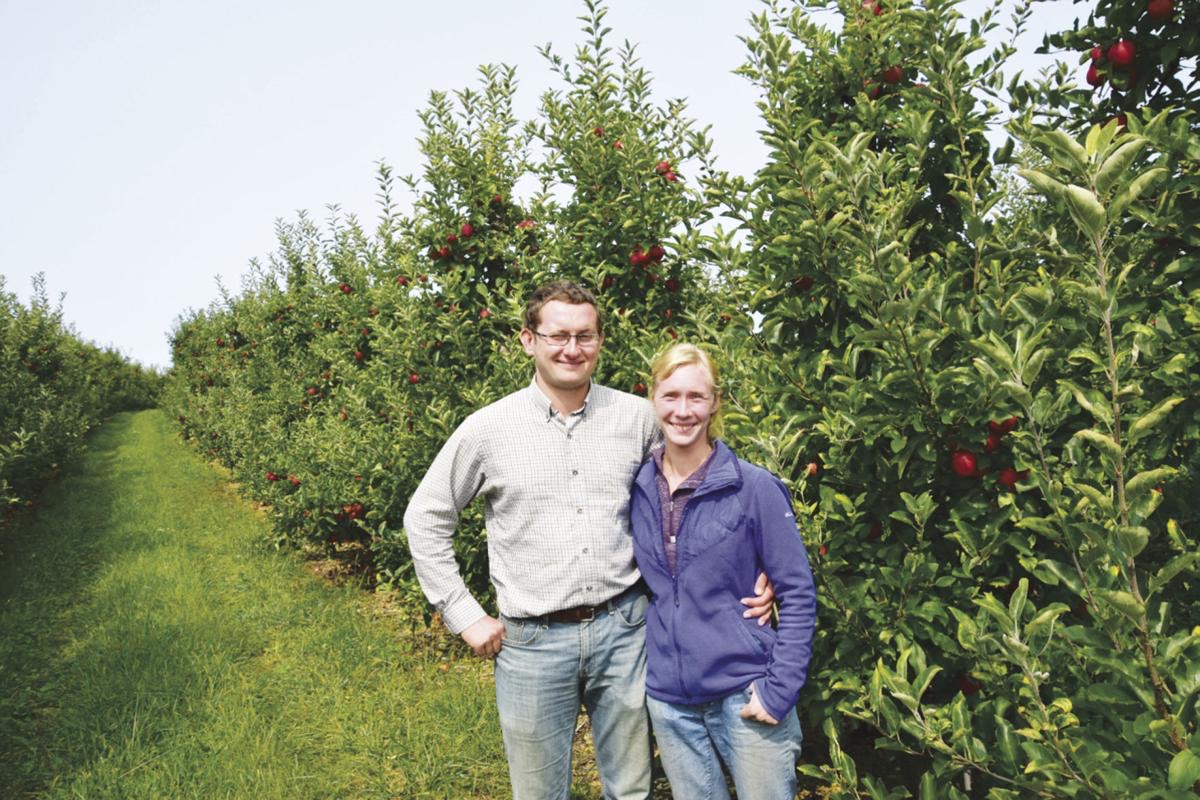
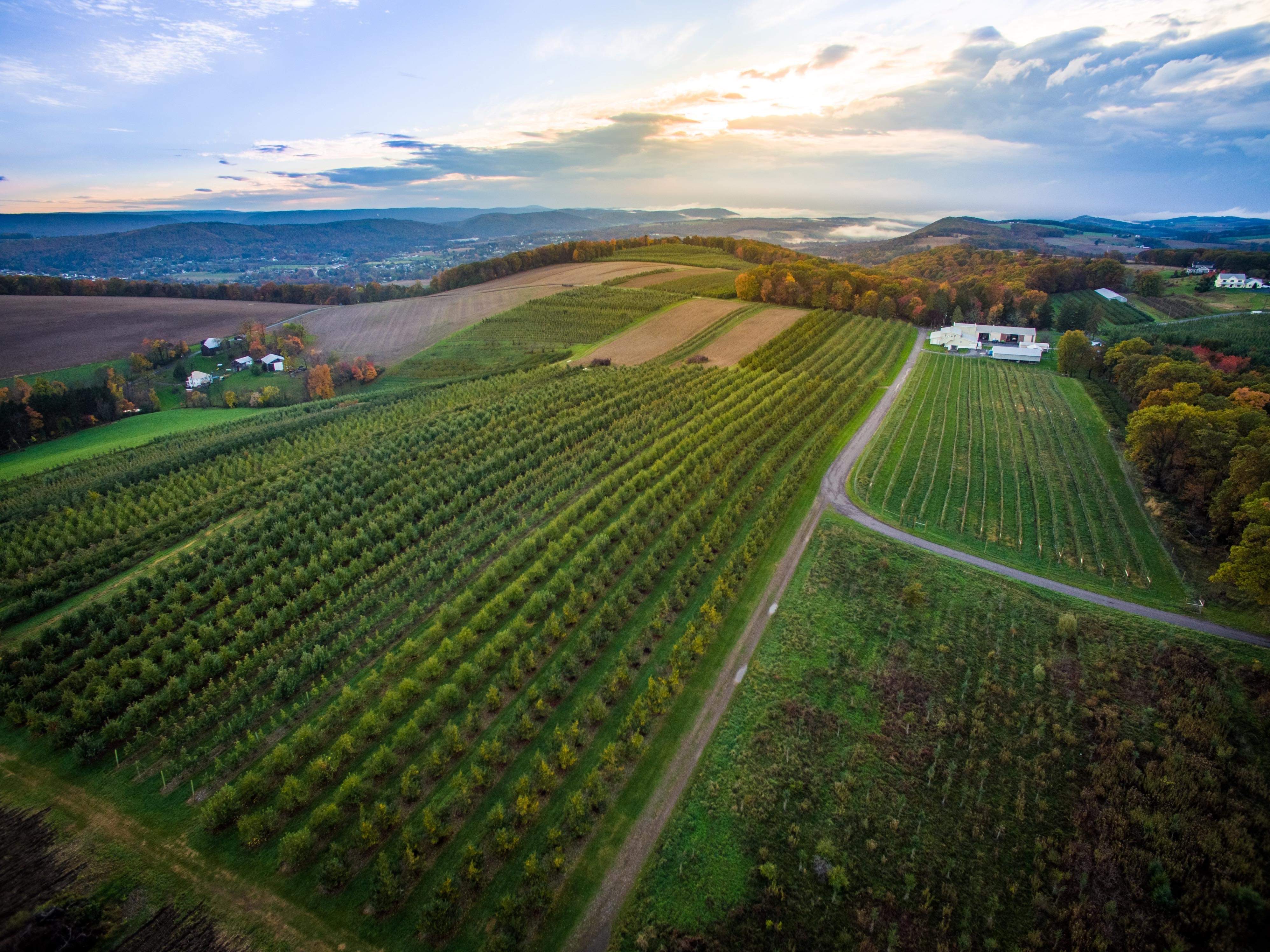
Tucked in the rolling hills of the Susquehanna Valley in Pennsylvania, surrounded by their orchards, live Bobby and Sara Hricko on their fourth-generation family farm. In generations past, inheriting the family farm was a natural and common path for a large portion of Americans. The path to farm life for Bobby and Sara, neither of whom grew up on a farm, was different. For them, becoming farmers was a very deliberate decision. And it was a decision they made after discerning that farming was a vocation given to them by God.
Life on the Farm
Green’s Fruit Farm has been in the family since Bobby’s great grandfather Robert Green bought the land in 1944. After decades of experimenting with a variety of animals and crops, Green eventually found success in shifting the farm’s focus in the 1980s to apples. Today, Bobby and Sara grow a wide selection of fruit: plums, cherries, nectarines, pears, and over 40 varieties of apples.
For the Hricko family, farming is more than just a job – it’s their life. Work is never done on the farm, they explain, and even when they’re not working, they’re always thinking and preparing. While Bobby and Sara had suburban childhoods, their three young children are growing up immersed in the day-to-day routine of life out in the country.
The all-encompassing nature of farming means that the community the Hricko’s have built up in the seven years they’ve been farming is almost entirely made up of people who interact with the farm, the people they work with and sell to. Because the Hrickos made the decision to switch from selling their produce to companies wholesale to selling directly to consumers, they have lots of direct interaction with the people who enjoy their fruit.
The Agricultural Vocation
When Robert Green bought the farm, roughly a quarter of the population of America worked in agriculture. Today, it’s only around 1%. In an era in which a comfortable suburban life is so readily available, Bobby and Sara gave it up to run a farm, with all the sacrifices that entails. The reasons came from the heart: a strong desire to work the land and a sense that God was calling them to a particular way of life.
Sara developed a love for gardening from an early age. It led her to pursue a degree in plant sciences at Penn State. While Bobby didn’t grow up on a farm either, he experienced farming firsthand as a teenager, working every summer for his grandpa on the same land he farms today.
“I just fell in love with it,” he says. “I felt very called to pursue a career in agriculture.”
He initially considered pursuing botany and forestry. He realized, though, that he didn’t just have a love of nature – he had a desire to participate in nature like a farmer does, cooperating with the sun, the weather, the soil, and the seasons to produce good crops. At the end of high school, he wasn’t sure whether he would go to college or jump right into farm work. In the end, he also chose to attend Penn State, where he met Sara in a shared class.
Their shared love of agriculture blossomed into a shared love for each other and they were married in 2019. The future of the family farm was uncertain at that time. Bobby’s grandpa died shortly after Bobby graduated college and the next generation of the family was not well prepared to take over the operations. For the newly-married Hrickos, it was providential. They took on married life and a new farm all at the same time.
From the get-go, the Hrickos saw the farm as a vocation. Their mission field, one could say, is quite literally a field. And the good fruit God is calling them to produce is, quite literally, good fruit.
“One thing that’s very clear is that God is not calling us to just grow fruit and sell it for a profit,” says Bobby. “The ultimate end goal is actually to inform and educate the public about agriculture, to be a voice for agriculture, and to advocate for the rural way of life.”
Sara explains that she is especially motivated by a desire to be a good caretaker of the land. “Not too many people, especially people at our age, get an opportunity like this… to take care of a hundred acres of land that’s given to us by God,” she says. “It’s our job to steward it appropriately.”
The Sweat of the Brow
As any Catholic who has seriously discerned priesthood, religious life, or marriage knows, a vocation from God will bring great joy, but it isn’t meant to be a bed of roses all the time. In their vocation on the farm, Bobby and Sara have taken up their cross from the beginning.
After taking over the farm, they quickly discovered how daunting the task that lay ahead was. Keeping the farm afloat took long hours of hard work and a lot of learning on the fly. Despite their education in agriculture, they found that much can only be learned through experience. What makes the learning curve difficult, they say, is that a farmer doesn’t have much room for failure – there are deliveries that must be made, customers that must be served, debts that must be paid, and seasons that must be respected.
Bobby admits that early on, there were days when the farmwork used to feel very purposeful, but felt soul-sucking.
“It’s really, really important for us to keep coming back to the fact that God is calling us to be here and calling us to do this,” he says. “Making that commitment every day is really difficult. It's really tough, but knowing that this is what we're called to do and pursuing that calling, even though it can be extremely challenging, that's what keeps us going.”
In an era in which so few people farm, it can also be difficult to feel understood. In their parish community, there aren’t other farm families.
“We're parents of young kids [so] I am looking a lot for community,” says Sara. “The Catholics that we're trying to connect with – even if they want to understand – it is really hard to understand this lifestyle if you don't live it.”
And in their area, there are very few Catholics. In their work, they interact much more with Mennonites and Amish than they do with Catholics. In the constant work of the farm, it’s hard to find any time to participate in any community that isn’t farm-related.
“[For] the average family, a common question is ‘what should we do this weekend?’” says Bobby. “Our common question is ‘what weekend this month can we carve out to do something?’”
It’s not to say, by any means, that their way of life isn’t worth it. In fact, the Hrickos have a hard time imagining a life off the farm. They’re especially grateful for the fruits farming has borne in their family life, not the least of which is the ability to spend time together all day.
“I really feel that the biggest blessing of farming is to be able to raise the kids here,” says Sara. “They have a lot of different experiences and flexibility in what they can do… I can’t imagine raising a boy [off the] farm – he’s so active, he wants to do everything, be outside like literally 24/7 if you let him.”
The farm doesn’t just help bring them closer to one another – it also helps bring them closer to God.
Bobby explains that rural life is conducive to the Christian life in that it teaches the value of both community and commitment.
“If you're living a lifestyle where you're committed to milking the cows every day, or you're committed to fertilizing the crops every three weeks, or if you're committed to showing up at a mechanic shop to fix a tractor because the farmer needs that tractor to get his work done, that commitment translates really well into strong faith communities because commitment is already part of your lifestyle,” Bobby explains.
For Sara, farming is a reminder of our need to trust in God.
“Suddently a weather event [can wipe] out your crop,” she says. “You have to lean on God and your community at that point.”
Making All Things New
As the Hrickos look to the future, there’s a new part of their mission they are particularly excited about: delving into regenerative farming.
“Rather than just maintaining things and stopping them from degrading, we're focused on trying to build systems that actually make the farm better and healthier,” Bobby explains. “Regenerative agriculture is about designing systems that continuously improve the agro-ecosystem.”
Like everything on the farm, it’s a group project. The Hrickos are excited to work with other farmers looking to renew their farms through regenerative agriculture, sharing what they learn along the way and learning from what others discovered.
It’s an example of how, as Saint Paul writes in 2 Corinthians, in Christ, all things are made new. The Hrickos, in their own unique way of following Christ, are making things new at Green’s Fruit Farm. It is where they started their new family, renewed the family farm, and continue to steward the land, working to make it even better than before. And with God’s help, it is only the beginning.
You can learn more about the Hrickos and Green's Fruit Farm on their website, here.