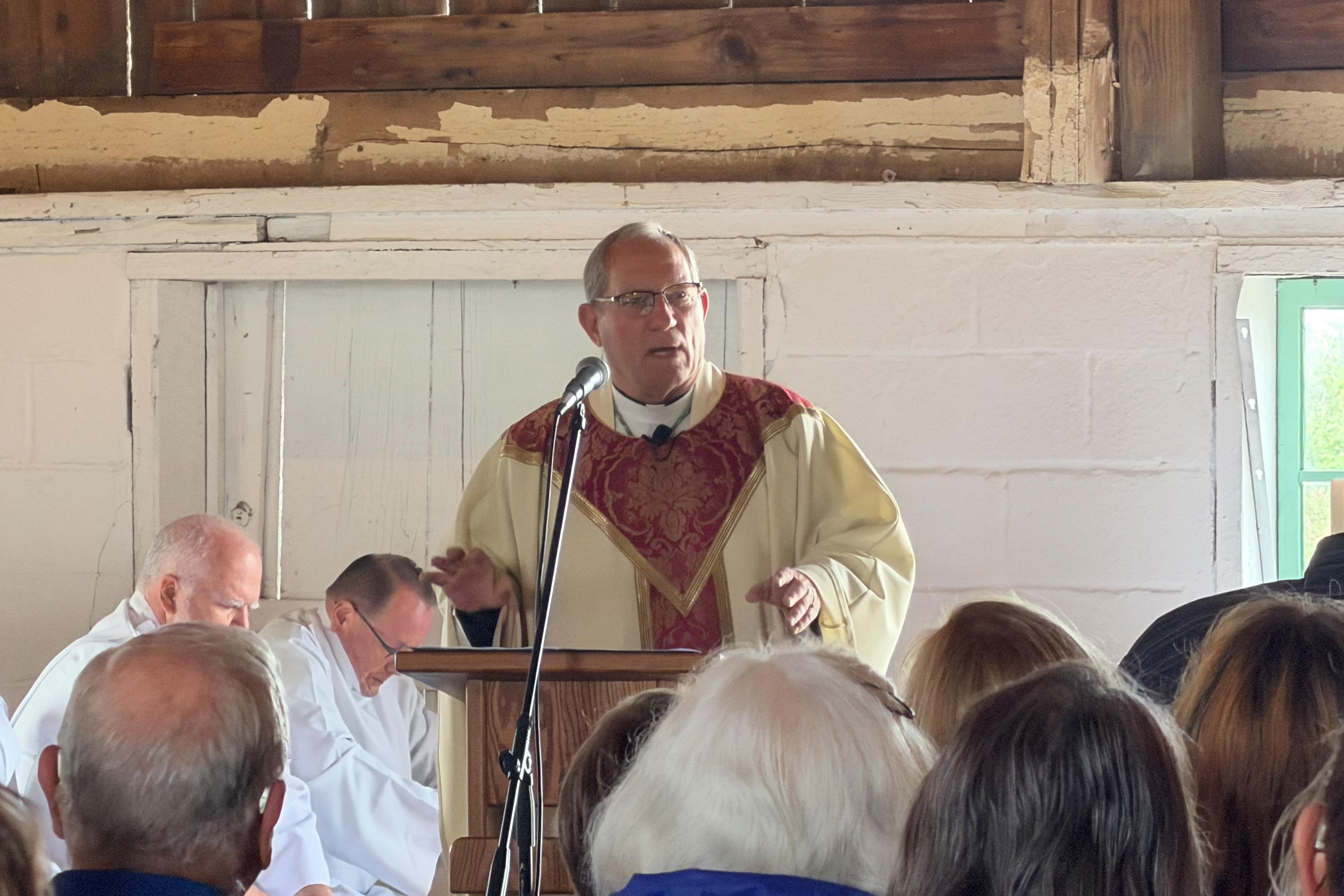
“Most of us just eat, but we don’t realize that eating really is a holy act, because everything that we receive from God should be holy,” said Bishop Robert Gruss during the Rural Life Mass in Clare, Michigan, Saturday, September 19th.
The Mass was held inside The White Barn, just outside of the city of Clare, hosted by Our Lady of Hope Parish and the Knights of Columbus. About 100 people prayed the Mass in celebration of farming and the rural community.
Bishop Gruss was joined by Monsignor Francis Koper, Fr. Dan Christi, and Fr. Vincent Oguejiofor, and three local deacons.
The readings for that day were taken from 1 Corinthians, and the Gospel of Luke. St. Paul’s letter to the Corinthians included the analogy of the seed and the resurrection of the dead, while Luke’s Gospel was the Parable of the Sower.
“Perhaps no one understands today’s readings better than those who work the land,” said Bishop Gruss, quipping, “Is this date picked because of the readings? Farmer, you understand seeds; you understand soil. You understand waiting; you understand the uncertainty of the weather.”
The bishop related the Parable of the Sower in Luke chapter 8 to what farmers continue to face. “Farmers understand something that our modern world often forgets. We are not in control of everything. A farmer can prepare the soil, it’s like good seed, maintain equipment, watch the forecast, work from before sunrise until dark, and yet after all of that labor, after all that labor, the farmer must entrust the seed to the earth, and the harvest to God.”
He explained each type of soil that the seed falls onto, including the rocky ground, the thorns and cultivating neglected soil faced by many in rural communities today, adding that they may have been different in Jesus’ day, but the pressure and trials continue.
“These storms, Jesus says, can slowly choke the light of grace. The Lord is not condemning in any way those who struggle. He’s inviting us to let him cultivate our hearts.” The bishop said “we are all called to conversion.”
Although many of the people participating in the Mass were farmers, the Bishop said, “Whether we’re farmers or not, the conversion is for everyone. Like the farm line in which you work the field of our hearts must always be attended to so that our lives will bear great fruit, not just fruits.”
The Bishop, who spent many summers growing up around family farms in rural Iowa, said, “soil can be broken open, stones can be removed, I remember as a kid there was moving stones out of the field.” He said soil can be cultivated and “neglected ground can become fruitful again.”
In his homily, Bishop Gruss recalled his experience with farming and rural life. “Rural life communities have always been something that’s near and dear to my heart. My father was a cattle buyer for Armour.” While he didn’t grow up on a farm, he spent a lot of time with family members in rural Iowa.
“I remember every summer, we’d go down (to his uncle’s farm) there for two or three weeks at a time, and I would help him and other area farmers put up hay in those 85 degree days, and it was great,” he said. “I’ve also worked on other farms, throughout my life, but I’ve always been attracted to this rural way of life.”
He said he even thought about becoming a farmer at one point, “However, as you can see, God had other plans for my life. It has not taken away my love for rural life. I want you to know, people, not just farmers, but all of you in rural communities, I appreciate your vocation as farmers and the sacrifices that you make, and the cooperating with God and bringing forth the fruits of the earth, and providing food in the world.”
Holding up a copy of The Vocation of the Agricultural Leader, published on the Catholic Rural Life website, Bishop Gruss said, “It reminds us that farming is more than an occupation of a business undertaking,” he said. “It’s a vocation, and is a way of life in which God, because all vocations are a way of life in which God can be made known, and can be served and glorified. It also calls those involved in agriculture to exercise moral leadership through respect and dignity, and service to the community, and responsible care for God’s creation.”
Not only farm workers, but anyone with ties to agriculture in any way, was honored during the Mass on Saturday. Bishop Gruss said there are many people who have connections to farming whose work is largely unseen. From researchers, to veterinarians, to food processors, truck drivers and those who stock the grocery store shelves. “All those who labor that are involved from your soil to the tables.”
Bishop Gruss prayed for the many families who have lost loved ones not only because the hard work impacted their health, but also because he said suicide rates among farmers is higher than the national average. “No one who carries these burdens can carry them alone,” he said.
Before dismissing the faithful for lunch, Bishop Gruss said part of the mission of Catholics in rural communities is to help people understand the reality that everything we take in is holy. “There’s also the understanding of where their food comes from,” he said. “You ask a young person today, where do you get your food? Where are they going to say? They have no concept of what happens in rural communities, and that’s sad.”
About 85% of the Diocese of Saginaw is rural, Bishop Gruss said, which means the church from Central Michigan to the tip of the Thumb is full of people who have a unique understanding of the importance of Catholic Rural Life. But he said the sad reality is that eating has been diminished and getting food has been diminished to just going to the grocery store.”
The Bishop, who is at the end of his term as the Chair of the Board of Directors for Catholic Rural Life, explained that the purpose of the organization is to get out into the communities and talk about farming and rural life in such a way that it’s not just something we get at the grocery store. “It’s people’s blood, sweat and tears that provides food for us. We can never forget that,” he said.